





 Add to Cart
 Calculate delivery
Product Description
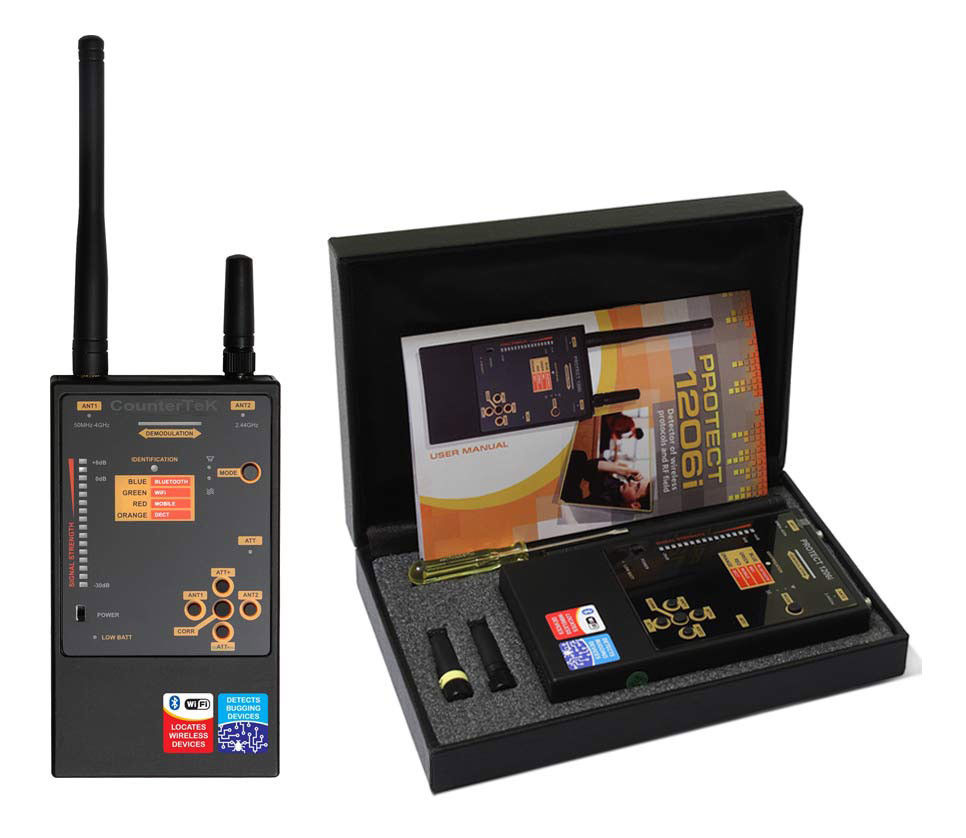
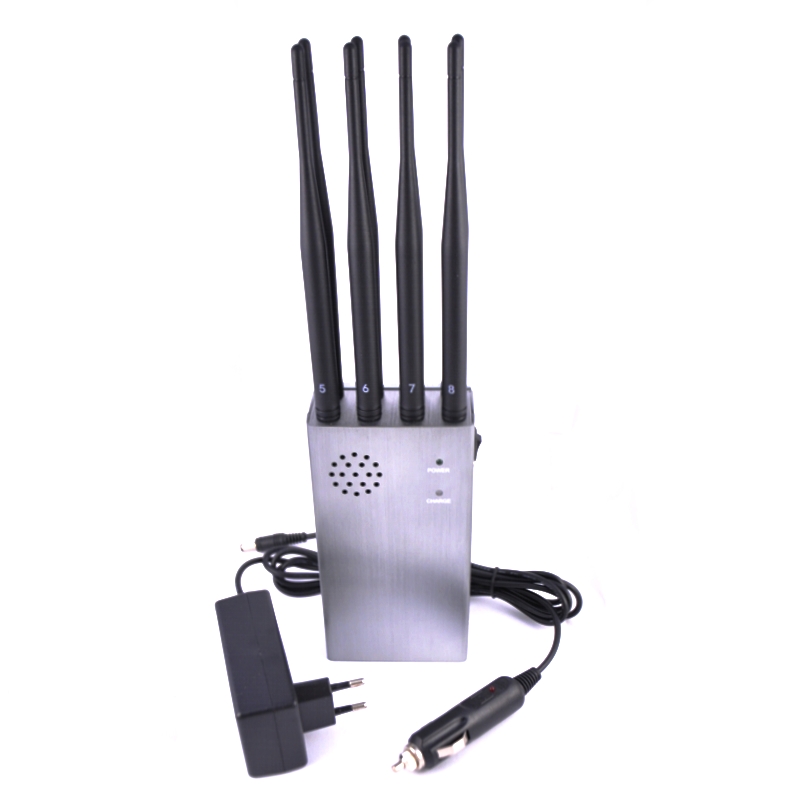
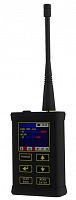
Protect 1206i Detector of eavesdropping devices and digital signals
This is a new class of anti-surveillance devices. Unlike all typical search devices, it is able to detect modern "hidden" bookmarks that use protocols such as Bluetooth and Wi-Fi over a long distance. Detectable protocols: VHF, UHF, GSM 900/1800/1900 MHz, 3G, Wi-Fi, Wi-Max, 4G (LTE) , etc. Operating range: Antenna 1: 50-6000 MHz; Antenna 2: 2.4 - 2.48 GHz, 4.9-5.875 GHz.
Protect 1206i is a new class of anti-surveillance devices. Unlike all typical search devices, it is able to detect modern "hidden" bookmarks that use protocols such as Bluetooth and Wi-Fi over a long distance. Such bookmarks, especially of the Bluetooth type, are virtually undetectable with conventional RF detectors due to their very low transmitted power and special type of modulation. The Protect 1206i uses a separate channel with a high-frequency (2.4/5 GHz) pre-selection mechanism to detect and localize Bluetooth and Wi-Fi with much higher sensitivity. The device then processes the demodulated signal in order to identify what was discovered in the Protocol. In addition, the device can detect all "classic" bookmarks and analyze them for the presence of correlation, sending sound pulses, as well as other digital transmissions at a standard distance (GSM, 3G, DECT, etc.)
The device you chose is not a slightly improved version of the old device, but a completely new detection tool with revolutionary changes.
New features
New broadband antenna (for ANT1 socket)
The wider coverage, especially at low frequencies, allowed for a 2-3-fold increase in the detection range of a conventional VHF/UHF bookmark, while maintaining perfect sensitivity at higher ranges (GSM Wi-Fi, Bluetooth, etc.).)
New Micro-Pointer Microwave Antenna (for ANT1/ANT2 socket)
For the first time, the available RF detector offers a microwave log-periodic directional antenna as standard. 2-4 times the distance to all sources above 2GHz (Wi-Fi 2.4 GHz, Wi-Fi 5GHz, Bluetooth, Wi-Max, LTE High, etc.). Directivity provides easy identification of the wireless source. Now you not only know that the Wi-Fi source exists, but you can quickly find it.
Increased dynamic range
The histogram now rises quickly to weak signals and slowly to strong ones, thus making it possible to find the source.
New attenuator
The new algorithm further expands the dynamic range, which simplifies the procedure for determining the location. Turn on the attenuator near a strong source, and the fully illuminated histogram will drop and then continue to increase, making it possible to determine the location more accurately.
Other features
- Extremely high sensitivity to Bluetooth, 2.4 GHz Wi-Fi, 5GHz Wi-Fi, and wireless video cameras
- Frequency range:
Main antenna ANT1: 50-6000 MHz:
ANT2 auxiliary antenna: 2.4-2.48 GHz, 4.9-5.875 GHz - The perfect tool for finding digital and analog transmitters of all types
- 16-segment histogram indicator
- 3 modes: sound, vibration and mixed
- The correlation function detects FM transmitters by the presence of a correlation (probing sound is used)
- 2 levels of sensitivity (attenuator)
- Long battery life
- Robust metal housing
- With microprocessor control
Specification:
|
Frequency Range |
Antenna 1: 50-6000MHz; Antenna 2: 2.4-2.48 GHz, 4.9-5.875 GHz |
|
Power supply |
Two AAA batteries (2xLR03) |
|
Overall dimensions |
Without antennas: 120x70x16 mm With antennas: 210x70x16 mm |
|
Current consumption |
Up to 30 mA |
|
Working hours |
Up to 20 hours |
|
Indications |
Active antenna, low battery, mode, identification, Attenuator, Secondary demodulation |
|
Micro-Pointer Antenna |
|
|
Frequency range |
2-12GHz; |
|
Type |
Log-periodic aerial array |
|
Model Name |
LPDA-12 |
|
Overall dimensions |
53 x 84 x 9 mm |
|
Connector |
SMA Male |
 Add to Cart
 Comparison











Copyright 2008-2022 © NAUSHNIKA.NET - The first Online Store of Earpiece. All rights reserved. Sankt Eriksgatan 82, 113 62 Stockholm, Sweden, |